- Presents a clear explanation of why the venture concept is a significant opportunity
- Provides a concise description of the venture's products or services
- Provides a clear, rational explanation of why the venture idea is better than anything else already available
- Succinctly explains customer benefits in qualitative and quantitative terms
- Provides a clear explanation of the one or two things the company does best
- Focuses on market-driven opportunities
- Provides evidence of customer acceptance of the venture's products and services
- Presents evidence of the marketability of the products and services
- Presents a quality, sophisticated, experienced management team, advisors, and board of directors with complementary and encompassing business skills
- Gives a clear sense of what the founders expect to accomplish in 3 to 7 years
- Provides a rational explanation of why the investor should trust the management team to do what they say they are going to do
- Identifies all the alternatives available to prospective customers
- Addresses how the venture will develop and sustain a distinct competitive advantage
- Addresses how the venture will develop and sustain a proprietary position
- Contains reasonable financial projections with key data explained and justified
- Shows how and when the venture will generate sustainable positive cash flow streams
- Describes the manufacturing and/or service delivery processes and associated costs in appropriate detail
- Explains and justifies the level of product development required
- Justifies financially the means chosen to sell the products and services
- Supports credible growth projections
- Provides a clear explanation of how the money invested in the venture will be used
- Shows how and when the venture will generate sustainable profit
- Shows an appreciation of investor needs
- Shows how investors can cash out in three to seven years, with an appropriate return on their investment
- Provides a clear explanation of what the investor will get for their investment
- Identifies significant risks and proposes rational contingencies
- Has the right appearance...not too fancy, not too plain
- Is arranged properly with the executive summary, table of contents, and chapters in right order
- Is the "right length"...not too long, not too short...to convey all the pertinent information
- Is plausible throughout
- Has facts rather than opinions
- Is quantitative rather than qualitative
- Stresses specifics rather than generalities
- Reads like a combination of the Wall Street Journal, a model of good business writing, and USA Today, a model of good story-telling
Showing posts with label Venture Plan. Show all posts
Showing posts with label Venture Plan. Show all posts
Characteristics of a Good Venture Plan
Choosing a Name
Picking a name for a new venture, product. or service is not easy. It may well be one of the hardest things we'll ever do in our venture.
Picking the wrong name could prove disastrous; the right name (brand) could add many sales dollars.
The following checklist should help. However, it is unlikely that any name will meet all these criteria, and there have been many successful names that met but a few.
Good luck!
- Can we get the .com URL for the name we want?
- Is the name distinctive?
- Is the name instantly recognized?
- Is the name easy to remember?
- Is the name pleasant to see?
- Is the name pleasant to say?
- Is the name easy to spell?
- Is the name itself confusing?
- Is the name easily confused with other names?
- Is there a connection between the name and the product, service, or business venture it represents?
- Does the name suggest what the business venture, product, or service does? If not, the tagline that accompanies the name may have to carry more communications weight.
- Is the name descriptive of the benefits offered by the product, service, or business venture?
- Does the name convey the proper image?
- Does the name fit customers expectations?
- Does the name reinforce customer expectations?
- Are there any negative connotations with the name
- Is the name limiting?
- Does the name coordinate with other names used in the organization?
- Does the name work in all target markets?
- Can the name be legally protected? Check with USPTO.gov and your state corporation commission to see if the name you want is already taken. If it is, start over!
- Can the name be used in other countries?
Competitive Research
- Who are our primary competitors?
- On what basis do we compete?
- What are our competitive positions?
- What are our respective market shares?
- What are their strengths?
- What are their weaknesses?
- What are their primary opportunities?
- How are they a threat to our venture?
- How do you compare to our competitors?
- Who are our future competitors?
- What strategic opportunities exist in the market?
- Can we collaborate rather than compete?
- What are the barriers to future competition?
- Who are the most likely future competitors?
Elements of a Marketing and Sales Plan
- Market research and analysis ... customers, problem, solutions, competition, risk and reward, resources, feasibility ...
- Opportunity
- Mission
- Business model
- Marketing objectives
- Sales goals
- Competitive advantage strategies
- Positioning strategies
- Target market and customer segments
- Product and service offerings
- Value proposition
- Pricing strategies
- Sales strategies and tactics
- Distribution strategies
- Promotional strategies
- Customer relationship management
Venture Map
The Venture Map identifies the key elements that must be addressed by every business venture. There are four categories:
1] The Environment, Markets, and Customers
2] The Transformation Processes including key venture processes (Management, Marketing, Innovation Engineering, Production Operations, Sales, Accounting, and Finance)
3] The Resources available within the venture to power the Transformation Processes (People, Places, Things, Time, and Money)
4] Innovation Activities (Exploration and Ideation, Vision and Mission, Goals and Objectives, Strategies and Tactics, Tasks and Assignments)
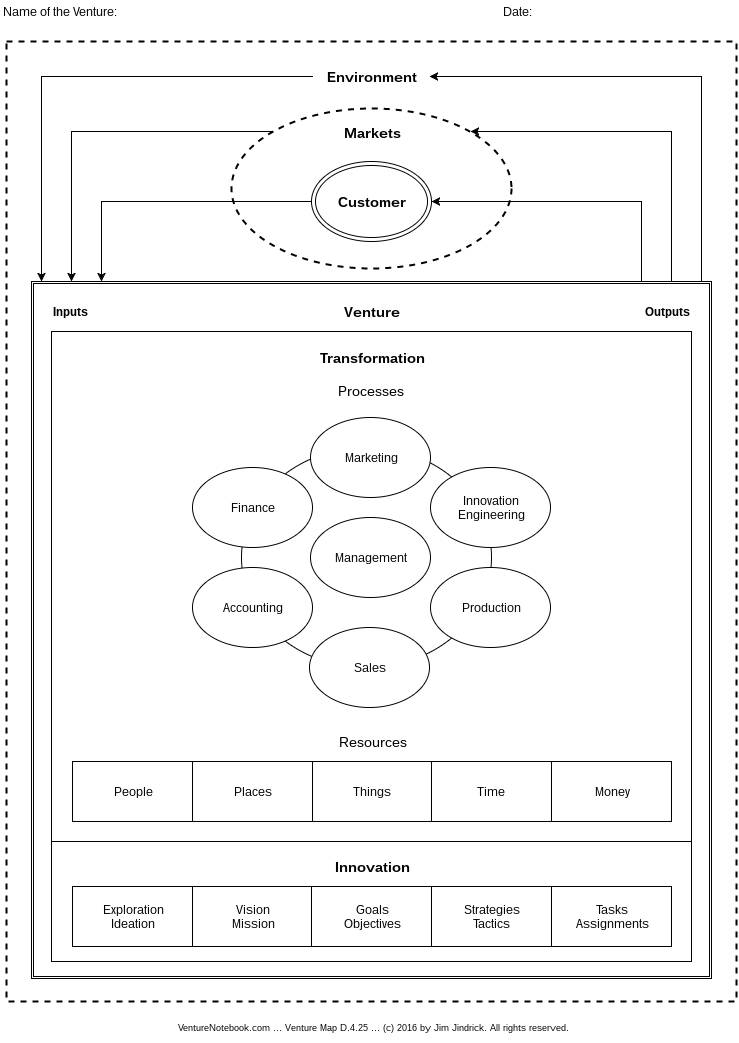
Critical Path in a Venture
Ultimately, the function of a business venture is to satisify customer needs, wants, and desires by transforming their problems into solutions (and capturing a bit of profit reward along the way).

Waterfall Venture Planning
- Vision ... "We will change the way someone does something!" [Be specific, 100 words or less: Who is someone? What is the something? Why are you going to change the way it is being done now? How?]
- Mission ... "We will earn a profit solving customer problems better than the competition!" [Be specific, 100 words or less: Who are the target customers? What are their problems? How will you solve them? What is the competition? How are you better? What will you do to earn the business? How will you make a profit? How much?]
- Goals ... "In five years, we will ..." [What are your three most important goals?]
- Objectives ... "To reach our goals, we must accomplish these objectives ..." [What are the three most important objectives for each goal that must be accomplished in the next six months?]
- Strategies ... "To accomplish our objectives, we will do this better than our competition ..." [What methods will you use to reach your objectives?]
- Tactics ... "To implement our strategies, we will do these things ..." [What three procedures will you use to carry out your strategies?]
- Tasks ... "To execute our tactics, we will ... " [What three things must be done to realize your tactics?]
- Assignments ... "Here's who is going to do what and when ... " [Who are the best people for each task?]
How to Create a Venture Plan
- Start with a clear, concise executive summary of your venture. Think of it like an elevator pitch. In no more than two pages, billboard all the important stuff. At the top, communicate your value proposition: what your venture does, how it will make money, and why customers will want to pay for your product or service. If you are sending your plan to investors, include the amount of money you need and how you plan to use it. You have to know the whole picture before you can boil things down, so tackle the summary after finishing the rest of your plan.
- Next, establish the market opportunity. Answer questions like: How large is your target market? How fast is it growing? Where are the opportunities and threats, and how will you deal with them? Again, highlight your value proposition. Most of this market information can be found through industry associations, chambers of commerce, census data or even from other business owners. (Be sure to source all of your information in case you are asked to back up your claims or need to update your business plan.)
- While you may have convinced yourself that your product or service is unique, don't fall into that trap. Instead, get real and size up the competition: Who are they? What do they sell? How much market share do they have? Why will customers choose your product or service instead of theirs? What are the barriers to entry? Remember to include indirect competitors--those with similar capabilities that currently cater to a different market but could choose to challenge you down the road.
- Now that you've established your idea, start addressing the execution ... specifically, your team. Include profiles of each of your business's founders, partners or officers and what kinds of skills, qualifications and accomplishments they bring to the table. (Include resumes in an appendix.)
- If potential investors have read this far, it's time to give them the nuts and bolts of your business model. This includes a detailed description of all revenue streams (product sales, advertising, services, licensing) and the company's cost structure (salaries, rent, inventory, maintenance). Be sure to list all assumptions and provide a justification for them. Also, include names of key suppliers or distribution partners.
- After all of that, one big question still remains: Exactly how much money will your venture earn? More important, when will the cash come in the door? That's why you need a section containing past financial performance (if your company is a going concern) and financial projections.
- Three-year forward-looking profit-and-loss, balance sheet and cash-flow statements are a must ... as is a break-even analysis that shows how much revenue you need to cover your initial investment.
- For early stage companies with only so much in the bank, the cash-flow statement comparing quarterly receivables to payables is most critical. "Everyone misunderstands cash flow," says Tim Berry, president of business-plan software company Palo Alto Software. "People think that if they plan for [accounting] profits, they'll have cash flow. But many companies that go under are profitable when they die, because profits aren't cash."
- After you've buffed your plan to a shine, don't file it away to gather dust. "A business plan is the beginning of a process," says Berry. "Planning is like steering, and steering means constantly correcting errors. The plan itself holds just a piece of the value; it's the going back and seeing where you were wrong and why that matters."
[Thank you, Mary Crane]
Venture Plan Presentation Slides
- Slide 1: "Billboard"
- Slide 2: Core Team ... who, what
- Slide 3: Problem / Customer / Opportunity ... scale and scope of problem, SOM/SAM/TAM
- Slide 4: Solution ... brochure
- Slide 5: Value Proposition ... Customer NWD Profile, Benefits, FFFF
- Slide 6: "Underlying Magic"... differentiation, competitive advantages, core competencies
- Slide 7: Industry and Environment ... Who, What, SWOT
- Slide 8: Competitive Analysis ... Who, What, SWOT
- Slide 9: Business Model ... BM canvas
- Slide 10: Go-to-Market Plan ... Strategies
- Slide 11: Sales Plan ... Objectives
- Slide 12: Operations ... Production, distribution, delivery, margin objectives
- Slide 13: Growth Strategies ... Scale and Scope
- Slide 14: Timeline ... What, when, where
- Slide 15: Financial Objectives and Key Metrics ...
- Slide 16: Use of Funds ...
- Slide 17: Funding Proposal ... Equity, debt, grants, gifts
- Slide 18: "Billboard"
Slides 19 to 100+ will have all the gory details!! Lists of 100: customers, prospective customers, target markets, competitors, prospective collaborators, suppliers, prospective investors, ...
These 18 slides also form the foundation for a formal written business plan and an executive summary.
Writing an Effective Venture Plan
- Tell your story, tell it quickly, and tell the truth.
- Make sure that on every page the reader gets the information you want them to get.
- Creativity helps, but scale it back and be traditional with your headings and your formatting.
- Use talking headings to send the reader in the desired direction.
- Brand your pages; use appropriate colors; use images and charts and graphs to help reader understand key points; write short paragraphs; use headings that help the reader follow the story you are telling; caption your charts/graphs; use graphics to highlight your sentences and use sentences to explain the graphics.
- Avoid fluff.
- Cite your sources.
- Every paragraph should represent a discrete chunk of information. Every paragraph needs a thesis sentence. This is normally the first sentence. The middle of the paragraph should add important information to elaborate on the main point. The last sentence of each paragraph should tie up the specific chunk of information and direct the reader to the next chunk of information in the next paragraph. The reader should know all of your main points by 'reading the first and last sentence of every paragraph.
- When using bullets or other formatting maneuvers, decide what you want to emphasize, then use the appropriate marking words or graphics. To emphasize importance, for example, use words or phrases that indicate value; if you emphasize time, then use words that indicate chronology. Make sure that the mixture of bullets and numbers you choose conveys the right tone.
- To proofread, print a copy and go through it out loud. Look for any place the reader stumbles out loud. Read it backwards if necessary. Have a friend outside of your team read it out loud and see where they get confused. Read slowly to catch basic errors. Allow adequate time to do all this ... it is time-consuming, so give yourself the time to become perfect.
- When in doubt, check for rules of grammar and usage with a handbook.
[Thank you, Dr Randolf Accetta]
Subscribe to:
Posts (Atom)