Showing posts with label READINESS. Show all posts

Three Key Characteristics of a Great Business Venture Concept

1] Is the concept technically feasible?  That is, does it violate the laws of physics (not a good thing!)?  Could the concept actually be produced and sold?

2] Is the concept venture viable?  That is, could a business actually be built from the concept?  Does it have some modicum of sustainability?

3] Does it require a reasonable level of resources?  Could those resource be rationally obtained?

Characteristics of a Good Venture Plan

  1. Presents a clear explanation of why the venture concept is a significant opportunity
  2. Provides a concise description of the venture's products or services
  3. Provides a clear, rational explanation of why the venture idea is better than anything else already available
  4. Succinctly explains customer benefits in qualitative and quantitative terms
  5. Provides a clear explanation of the one or two things the company does best
  6. Focuses on market-driven opportunities
  7. Provides evidence of customer acceptance of the venture's products and services
  8. Presents evidence of the marketability of the products and services
  9. Presents a quality, sophisticated, experienced management team, advisors, and board of directors with complementary and encompassing business skills
  10. Gives a clear sense of what the founders expect to accomplish in 3 to 7 years
  11. Provides a rational explanation of why the investor should trust the management team to do what they say they are going to do
  12. Identifies all the alternatives available to prospective customers
  13. Addresses how the venture will develop and sustain a distinct competitive advantage
  14. Addresses how the venture will develop and sustain a proprietary position
  15. Contains reasonable financial projections with key data explained and justified
  16. Shows how and when the venture will generate sustainable positive cash flow streams
  17. Describes the manufacturing and/or service delivery processes and associated costs in appropriate detail
  18. Explains and justifies the level of product development required
  19. Justifies financially the means chosen to sell the products and services
  20. Supports credible growth projections
  21. Provides a clear explanation of how the money invested in the venture will be used
  22. Shows how and when the venture will generate sustainable profit
  23. Shows an appreciation of investor needs
  24. Shows how investors can cash out in three to seven years, with an appropriate return on their investment
  25. Provides a clear explanation of what the investor will get for their investment
  26. Identifies significant risks and proposes rational contingencies
  27. Has the right appearance...not too fancy, not too plain
  28. Is arranged properly with the executive summary, table of contents, and chapters in right order
  29. Is the "right length"...not too long, not too short...to convey all the pertinent information
  30. Is plausible throughout
  31. Has facts rather than opinions
  32. Is quantitative rather than qualitative
  33. Stresses specifics rather than generalities
  34. Reads like a combination of the Wall Street Journal, a model of good business writing, and USA Today, a model of good story-telling

Technology Readiness Levels (TRL)

Most every new innovative idea has a fuzzy beginning. The idea may have potential, at least in someone's mind, but it also likely has "holes" in it.

Will it really work? What about this, what about that?

If we were to score this new idea, from 0 to 9, where would it be? Turns out, the European Commission has created a well-vetted method for scoring new ideas based on the stage of progress ... 0 being conceptual, 9 meaning the idea is out there and doing well in the world.


Traits of Successful Innovators and Entrepreneurs

Able to accept rejection ... able to build new structures ... able to build on the strengths of others ... able to communicate non-verbally ... able to concentrate ... able to control and direct ... able to cope well with novelty ... able to creates internal visualizations ... able to elaborate ... able to escape perceptual set and entrenchment ... able to express themselves ... able to fantasize ... able to find order in chaos ... able to focus ... able to get along well with others ... able to go beyond logical expectations ... able to handle abstractness ... able to identify problems ... able to imagine ... able to juxtaposition two or more incongruities ... able to keep an open mind ... able to keep options open ... able to make independent judgments ... able to observe trends ... able to organize ... able to perform "miracles" ... able to resist jumping to premature conclusions ... able to see inside-out ... able to solve collision conflicts for which there are no readily apparent solutions ... able to synthesize or combine ... able to think logically ... able to think metaphorically ... able to translate ideas into action ... able to use existing knowledge as base for new ideas ... able to use wide categories and images ... able to visualize ... able to visualize the future ... action-oriented ... adaptable ... adept with numbers ... alert to gaps in their knowledge ... alert to novelty ... ambitious ... analytical ... articulate ... attracted to challenges, not risks ... aware and empathetic of the needs of others ... aware of the world around them ... basically knowledgeable of their target area ... bold ... breaking the boundaries ... charismatic ... colorful ... confident ... considerate ... creative ... creative in a particular domain ... curious ... driven ... earthy ... emotionally appealing ... emotionally expressive ... emotionally stable ... empathetic ... enthusiastic ... ethical ... exciting ... expecting success ... expressive ... flexible ... fluent in areas of expertise ... full of energy ... futuristic ... get along well with others ... good at maintaining interpersonal relations ... good at timing ... good communicators ... good judgment ... good leaders ... good sense of timing ... have good communicative ability ... healthy ... humorous ... imaginative ... in good health ... in need of feedback ... in need of high achievement ... in possession of a positive attitude ... independent ... independent in outlook ... independent in thinking ... innovative ... inquisitive ... intelligent ... intense ... inventive ... know how to organize ... knowledgeable ... listeners ... lively ... loaded with energy ... logical ... looking for opportunities in problems ... looking for problems to solve ... magical ... maintain good interpersonal relations ... not status seekers ... not willing to give up ... objective in their approach to interpersonal relationships ... open-minded ... original ... possessing a sense of urgency ... possessing a vivid imagination ... possessing stamina ... possessing superior conceptual ability ... possessing supra-rational creative abilities ... possessing wide and varied interests ... productive ... proud of what they do ... rational ... realistic ... resistant to closure ... resourceful ... self-confident ... self-starting ... self-sufficient ... sensible ... sensitive to problems ... skilled decision makers ... skilled in good judgment ... sociable ... stimulated by variety ... tactful ... take pride in what they do ... unwilling to conform ... welcome responsibility ... willing and able to make decisions ... willing to accept responsibility ... willing to ask "why?" ... willing to invest in the future ... willing to question norms and assumptions ... willing to solve puzzles ... willing to take a chance ... willing to take calculated risks ... willing to work hard ... word fluent ...

Competitive Research

  1. Who are our primary competitors?
  2. On what basis do we compete?
  3. What are our competitive positions?
  4. What are our respective market shares?
  5. What are their strengths?
  6. What are their weaknesses?
  7. What are their primary opportunities?
  8. How are they a threat to our venture?
  9. How do you compare to our competitors?
  10. Who are our future competitors?
  11. What strategic opportunities exist in the market?
  12. Can we collaborate rather than compete?
  13. What are the barriers to future competition?
  14. Who are the most likely future competitors?

Elements of a Marketing and Sales Plan

  1. Market research and analysis ... customers, problem, solutions, competition, risk and reward, resources, feasibility ...
  2. Opportunity
  3. Mission
  4. Business model
  5. Marketing objectives
  6. Sales goals
  7. Competitive advantage strategies
  8. Positioning strategies
  9. Target market and customer segments
  10. Product and service offerings
  11. Value proposition
  12. Pricing strategies
  13. Sales strategies and tactics
  14. Distribution strategies
  15. Promotional strategies
  16. Customer relationship management

Phases of Innovation

  1. Preparation ... focus on the problem or opportunity, and who it affects
  2. Exploration ... identify current solutions, alternatives, and substitutes
  3. Stimulation ... use creativity techniques to trigger new ideas, concepts, and solutions
  4. Incubation ... give the new ideas some time and thought
  5. Illumination ... identify new ideas, concepts, and solutions
  6. Selection ... establish and use clear criteria for selecting the "best" concept
  7. Planning ... decide how to implement the concept
  8. Implementation ... put the plan and concept to work
  9. Evaluation ... determine if the new concept is working
  10. Iteration ... apply incremental improvement to the concept, or start over

Mission Statement

A mission statement is a description of how the team will achieve the vision for the venture. A mission statement should include a summary of ...

  1. Core values
  2. Target customers
  3. Stakeholders
  4. Products
  5. Competitive advantage
  6. Values provided to customer
  7. Markets served
  8. Industry

Mission statement seed: "We will earn a profit solving customer problems better than the competition."

SCAMPER

To create a new product, service, or process, try applying "SCAMPER" to an old one. SCAMPER is an acronym for ...

  1. Substitute ... What can you substitute? What can be used instead? Who else instead? What other ingredients? Other material? Other process? Other power? Other place? Other approach? Other sounds? Other forces? ... "Instead of ... I can ..."
  2. Combine ... What can you combine or bring together somehow? How about a blend, an alloy, an assortment, an ensemble? Combine units? Combine purposes? Combine appeals? Combine ideas? ... "I can bring together ... and ... to ..."
  3. Adapt ... What can you adapt for use as a solution? What else is like this? What other idea does this suggest? Does past offer a parallel? What could I copy? Who could I emulate? ... "I can adapt ... in this way ... to ..."
  4. Modify, minimize, magnify ... Can you change the item in some way? Change meaning, color, motion, sound, smell, form, shape? Other changes? ... Also: 'Minify': What can you remove? Smaller? Condensed? Miniature? Lower? Shorter? Lighter? Omit? Streamline? Split up? Understate? ... Also: Magnify: What can you add? More time? Greater frequency? Stronger? Higher? Longer? Thicker? Extra value? Plus ingredient? Duplicate? Multiply? Exaggerate? ... "I can modify/minimize/magnify.. in this way ... to ..
  5. Put to another use, re-use ... How can you put the thing to different or other uses? New ways to use as is? Other uses if it is modified? ... "I can re-use ... in this way ... by ..."
  6. Eliminate, elaborate ... What can you eliminate? Remove something? Eliminate waste? Reduce time? Reduce effort? Cut costs? ... "I can eliminate ... by ..."
  7. Rearrange, reverse ... What can be rearranged in some way? Interchange components? Other pattern? Other layout? Other sequence? Transpose cause and effect? Change pace? Change schedule? ... "I can rearrange ... like this ... such that ..."

[Thank you, Robert Eberle and Alex Osborn]

Differentiation

Every successful business is differentiated from its competition ... it could be very unique and significant, or it may be seemingly small and minor. But customers choose one enterprise over another for a reason. Following are some potential sources of value and differentiation to use as a guide when creating a competitive advantage strategy ...

ambiance ... branding ... business model ... community service ... contrived deterrence ... convenience ... copyrights ... cost advantages ... cost advantages independent of scale ... customer relations ... customer responsiveness ... customer service ... delivery ... distinct unique competencies ... economies of scale ... effective sales methods ... efficiency ... experience of doing business ... features ... functionality ... government regulation ... high quality ... image ... innovation ... intellectual property ... limited resources ... location ... low-cost ... manufacturing innovation ... market positioning ... market segmentation ... operational methods ... patents ... performance ... price ... product design ... product differentiation ... product innovation ... product selection ... product-line breadth ... quality ... rarity ... relationships ... reliability ... reputation ... selection ... service ... shopping experience ... supply chain relations ... switching costs ... trademarks ... trade names ... unique capabilities ... value

Conjoint Analysis

Conjoint analysis is a statistical technique used in market research to determine how people value different features that make up an individual Product or Service. The objective of conjoint analysis is to determine what combination of a limited number of attributes is most influential on respondent choice or decision making. A controlled set of potential products or services is shown to respondents and by analyzing how they make preferences between these products, the implicit valuation of the individual elements making up the product or service can be determined. These implicit valuations (utilities or part-worths) can be used to create market models that estimate market share, revenue and even profitability of new designs.

Advantages

  1. Estimates psychological tradeoffs that consumers make when evaluating several attributes together
  2. Measures preferences at the individual level
  3. Uncovers real or hidden drivers which may not be apparent to the respondent themselves
  4. Realistic choice or shopping task
  5. Able to use physical objects
  6. If appropriately designed, the ability to model interactions between attributes can be used to develop needs based segmentation

Disadvantages

  • Designing conjoint studies can be complex
  • With too many options, respondents resort to simplification strategies
  • Difficult to use for product positioning research because there is no procedure for converting perceptions about actual features to perceptions about a reduced set of underlying features
  • Respondents are unable to articulate attitudes toward new categories
  • Poorly designed studies may over-value emotional/preference variables and undervalue concrete variables
  • Does not take into account the number items per purchase so it can give a poor reading of market share

[Thank you, Wikipedia]

Vision Statement

A Vision Statement is essentially a high-level summary of what the venture team wants to accomplish, typically within the next five years.

Everyone in the organization should be able to connect their activities to making this vision a reality.

A vision statement should be ...

... clear, focused, easily understood, and easy to remember.

... consistent, constant over a period of time, but adjustable as conditions warrant.

... unique and special to the venture.

... purposeful, providing a reason for being and for others to care.

Vision Statement seed: "We will [change the way] [our customers ... who?] [do something ... what?] because [we have something new and better ... what?]."

Sometimes the terms "Vision" and "Mission" are reversed ... personally, I am set on a Vision Statement being a long-term goal, and the Mission Statement being day-to-day guideline for achieving the Vision.

Neither the Vision or the Mission statements should be fluff. They should be well-thought-out and act as solid anchors for the venture. No BS!  No "wink and smile" when we read them, especially when we read them aloud!

Iteration

Creating something new and better is seldom a smooth start to finish process. More often it's a start, test, iterate, refine, re-start, re-test, re-iterate, get frustrated and quit!!  No!!  Don't quit ... that's too much like "fail".  The "in" word these days is pivot ... we didn't quit, we did a pivot. So maybe we're not moving in the original direction we had in mind, maybe we took a hard turn to the right or left. But ... we're still moving, and that's (usually) good!


I
It starts with an idea, it always does! The first question, "Who cares? Are there any customers for our idea?" If the answer is yes, we think so, move on to the next stage of development: a] create a business model that will fit our target customers and our idea; and b] develop our product and/or service in steps that can be tested and refine (agile engineering, it's called). If our first customers are happy with the results, find more and more customers and build up our venture. If our first customers aren't all that thrilled, iterate either our business model or our product/service, or both!

Elevator Pitch

An Elevator Pitch is succinct and persuasive sales spiel that takes about as long as riding an elevator from the ground to floor 42 (30 seconds, give or take). Some humor intended!  It's Bill and Melinda Gates in the elevator with you, by chance, and 30 seconds is all you're going to get!  Are you ready?

  1. Begin with an end in mind: What is it that you are looking to gain? Most often the pitch is used as a tool to capture enough interest to warrant a formal
  2. Sell, Sell, Sell: What are you really selling? You are selling yourself! You're selling your dream. Be confident and show your passion.
  3. Keep it simple: You should deliver a clear, compelling and simple image of your opportunity that is easy to remember and repeat. You want the audience to say, "I get it!"
  4. Image is everything: The pitch must implant a clear image of your opportunity in the mind of the audience.
  5. Adapt your presentation to the audience: The same pitch you use for an investor might not be the same as to a supplier. (For the sake of simplicity, the term audience is used in a generic sense to include an investor, supplier, employee, customer or even a judge in a competition.)
  6. Lay out the benefits: Demonstrate how your business will impact consumers and showcase the return to the investors.
  7. Differentiate yourself from the competition: Focus on outlining the special features of your product/service that gives you the edge over the competition. Time permitting, summarize the competitors and insert facts or statistics where necessary.
  8. Don't forget the numbers: Depending on the audience, you need to insert a snapshot of your financials and other critical data. For example, "In year three we expect to capture 3 percent of the market, giving us $30 million in sales revenue." Investors also want to know the amount of investment you need and the return on investment (ROI).
  9. Be memorable: Use your creativity and imagination. Put a tag on it! For example: Chevy - Like a rock. Nike - Just do it! BMW - The ultimate driving machine.
  10. Conclude with a call to action: For example, "Thank you for the opportunity to pitch my idea. I'd be glad to provide greater detail over a lunch." The best pitch is useless without any follow-up action.
  11. Practice! Practice! Practice! While there are always a few naturally-gifted speakers out there, the more you rehearse your pitch the more natural it will flow and the more confident you will appear. Remember that showing confidence and passion helps sell your idea.  Practice, yes, but don't memorize and start sounding rehearsed ... go with the flow of the listener!
  12. Don't give up: Some people may not understand your opportunity at first, so don't get discouraged or quit. Walt Disney pitched his idea for Mickey Mouse to more than 300 banks before he received funding.  (Now that's a Mickey Mouse pitch I would love to have heard!)

Skills for Success

Although every business requires a specific skill set and related domain knowledge, there are some general qualities which you must develop if you want to get going in any business. I say 'develop' and not 'have' because I don't think these skills are rocket science and if you've got the willingness, you can easily develop them and carry on your business in a better manner.

  1. Be A Visionary ... Yeah, I know what you are thinking. Here comes the first cliche; I'll agree. But when I say be a visionary, I don't mean you should have grand visions right from the start. There should be a definite goal in your mind and you should work towards achieving that goal. You could always start with small goals initially and every time you achieve them, set yourself new challenges. And soon you'll find that you've got a vision, a vision which you never thought you could achieve and now, it suddenly seems possible.
  2. Be Adaptable ... Now here's the thing - you develop a strategy and start working towards your goal. But the world's changing everyday and soon you realize that the strategy isn't working. In this case, you should immediately adapt to the changes and adopt new methods of working while keeping your vision intact.
  3. Mix Passion With Planning ... If you aren't passionate enough, chances of your succeeding in your business are slim. But if you get carried away by passion, that's equally harmful for your work. Hence the idea is to mix passion and enthusiasm with planning and execution.
  4. Communicate Like A Pro ... It's not only about talking to the other person or to your client. It's about every form of communication, be it on phone, through email, through a letter or any other way of sending your thoughts across. Effective communication is one of the must have leadership skills and if you think you aren't very good at this, prepare to learn how to communicate in the most effective manner, convince others and get more business.
  5. Network Like A Pro ... Another essential ingredient for success in business. Identify the right people and establish relationships which are long lasting. Apart from helping you in your business, these relationships can also help in your personal life.
  6. Be Aggressive ... Being aggressive doesn't mean you are always pumped up and blindly grab every opportunity that comes in your way. It means you are ready to take risks, sometimes calculated and sometimes out of your gut-feeling. It means you aren't satisfied with an achievement and are hungry for more. It means you are available 24X7 for your work. And yes, it also means you are ready to make sacrifices when required.
  7. Be Persistent ... Without a doubt, persistence is a must-have trait for anyone who hopes to make it big in his business. So what exactly is persistence? Here's how Seth Godin defines it: "Persistence isn't using the same tactics over and over. That's just annoying. Persistence is having the same goal over and over."
  8. Do Things Differently ... That's what winners do, isn't it ? Apply new techniques and tricks to an already existing business model instead of trying to search for that new idea. You'll save time.
  9. Learn Everyday ... Really, the learning never stops when you are self employed. And you should never let it stop either. No matter how big your business grows, you should keep learning everyday and apply new techniques to make your business better.
  10. Never Be Complacent ... If organizations like Enron and WorldCom can bite the dust then anything can happen. No business, absolutely no business can be considered fool-proof. One mistake and the empire could crumble. Complacency is usually the first step towards this destruction. So better not be complacent.

[Thank you, Abhijeet Mukherjee]

The Big Steps

 [This worksheet is currently incomplete and under construction.]

Step 1: Creating Concept POTENTIAL Value

Step 2: Preparing Venture READINESS for Development

Step 3: Raising the RESOURCES Necessary for Venture Launch

Step 4: Go!

Venture Map

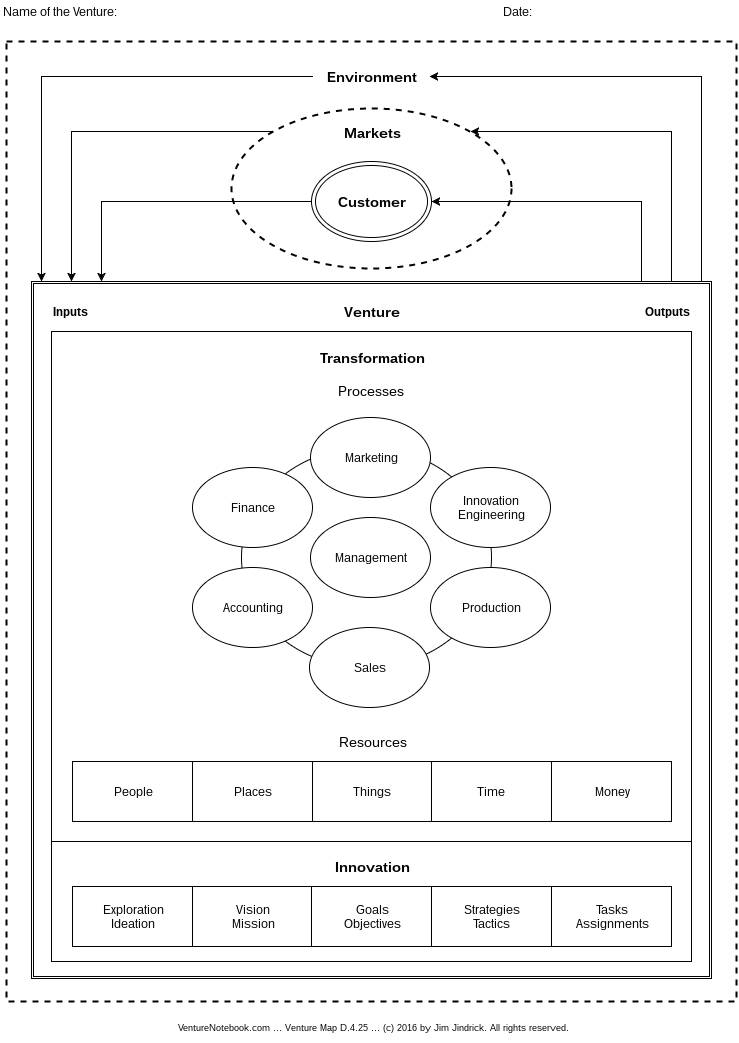
The Venture Map identifies the key elements that must be addressed by every business venture. There are four categories:


1] The Environment, Markets, and Customers

2] The Transformation Processes including key venture processes (Management, Marketing, Innovation Engineering, Production Operations, Sales, Accounting, and Finance)

3] The Resources available within the venture to power the Transformation Processes (People, Places, Things, Time, and Money)

4] Innovation Activities (Exploration and Ideation, Vision and Mission, Goals and Objectives, Strategies and Tactics, Tasks and Assignments)

Venture Organizational Structure

Figure 5 outlines a somewhat standard every-business-looks-like-this flowchart. Internal communication channels are numbered 1 through 6, communication channels between the organization and its customers are lettered A through E. Each of these network elements can be further detailed in a hierarchical manner using the HITO Graphic Tool.


Figure 5: Business Venture Communications Network Tool


The "alpha" communication channels in Figure 5 are external, between business venture departments and customers:

A] The Innovation Department communicating with customers to determine what customer problems, needs, wants, and desire the venture should address

B] The Marketing Department communicating with customers to promote current venture solutions, product, services, and processes that solve current customer problems, and obtain feedback from customers relating to the performance of the venture in solving their problems

C] The Sales Department obtaining and processing orders from customers, and customer relationship management

D] The Operations Department building and delivering solutions, products, and services to fill customer orders

E] The Finance/Accounting Department collecting payment for the value delivered to customers by the products, services, and processes provided by the venture

The "numeric" communication channels in Figure 5 are internal, the information being shared between departments in a business venture.

1] Marketing and Innovation Development Departments share information about customer problems, needs, wants, and desires, and the benefits, fit, form, function, and features of new products, services, and processes being created in the organization.

2] The Marketing and Sales Departments coordinate information about the benefits, fit, form, function, and features of currently available solutions, products, services, and process that match customer requirements, including the price of the offerings.

3] The Sales Department communicates information about customer orders to the Finance/Accounting Department such that the customer is properly billed when the solutions, products, and services are delivered.

4] The Sales Department communicates information about customer orders to the Operations Department such that the appropriate products and services are delivered to the customer.

5] The Operations Department communicates information about product and service delivery to the customer so the Finance/Accounting Department can accurately bill the customer.

6] The Innovation Department (often called the Engineering Department) provides the Operations Department with bills of material and assembly instructions for creating the solutions, products, and services being sold to customers.

While there are many other useful tools, those outlined in this paper have proven to provide excellent results for a mentoring a new business venture development team.

Tips for Promotion

 A way to attract attention to our venture is to choose an advertising or promotional medium that is unusual for our industry. Here are some ideas ...


Advertorials ... attention getters ... balloons ... billboards ... blog marketing ... brochures and pamphlets ... bulletin board signs ... bumper stickers ... bus and taxi ads ... bus bench/shelter signs ..

business breakfasts/lunches ... business cards ... business networking ... buttons ... calendars ... charitable contributions ... high profile ... charitable volunteerism ... city/regional magazine advertising ... classified advertising ... community involvement ... computer bulletin board ... computer data service ... consumer magazines ... contests ... co-op advertising ... customer newsletters ... decals ... demonstrations ... developing a sales slogan ... direct mail and sales letters ... direct mail with co-op advertising ... discount coupons ... discount premium books ... door hangers ... door-to-door canvassing ... drive-time radio ... employee events ... endorsements or promotion by famous personalities ... enthusiast magazines ... envelope stuffers ... envelope advertisement ... event sponsorship ... exterior building signs ... fliers and circulars ... folders and binders ... format radio ... free information ... free trials ... general business magazines ... gifts and premiums ... grand opening/anniversary celebrations ... greeting cards ... grocery store cart signs ... home parties ... hot air balloon ... Internet ... letterhead ... local business magazines ... local cable ... local newspapers ... local TV ... loudspeaker announcements ... magazine ... mailing labels ... major network TV ... membership in organizations ... messages pulled by airplane ... moving billboards on trucks ... mugs ... magnetic holders ... etc. ... multiple purchase offers ... national cable ... national newspapers ... news releases ... newsletters ... newspaper ad ... newspaper insert ... offer a reward for referrals ... on-line computer services ... package inserts ... packaging ... per-order/per-inquiry ads ... personal letters ... personal sales ... picket your establishment ... place mats ... point-of-purchase signs ... postcards ... price specials ... print advertising ... print on the box/container ... product exhibitions ... programs and yearbooks ... promotional plan chart ... proposals ... public relations and publicity ... radio advertising ... radio spots ... rebates ... referral incentives ... reminder advertising ... sales calls ... sales incentives ... sales tools ... samples of product ... search lights ... seminars ... free or low-cost ... send a thank you note after a new purchase ... share costs with event sponsors ... shopper classified newspapers ... sidewalk signs ... signs at sporting events ... signs on your building ... signs towed by airplanes ... skywriters ... special events ... special sales ... specialty items ... spokesperson ... sponsorship of charitable events sponsorships ... statement stuffers ... stickers ... symbols ... take-one racks ... talks and presentations ... tape or ribbon ... telemarketing ... telephone hold messages ... telephone pole signs ... television advertising ... television spots ... thank-you letters ... tie-ins with other products ... tours ... trade and technical magazines and newspapers ... trade fairs ... trade journal advertising ... t-shirts ... two-for-one offers ... vehicle signs ... video commercials in stores ... video tapes ... walking signs ... window signs ... and yellow page advertising ...

Traits of a Good Press Release

  1. Trait #1 – Make sure the organization you belong to is very clear.  Placing this information at the top is a good start.
  2. Trait #2 – If your press release doesn’t contain news, you may as well not even send it.  Promise news at the top with “NEWS RELEASE” in a larger font than the rest of the press release.
  3. Trait #3 – One of the main traits of news is that it is current.  Since you are offering news, make sure it is as current as possible.
  4. Trait #4 – Get the name of the person you are sending your press release to and place it in a prominent position.  Be sure to double check the spelling.
  5. Trait #5 – Provide a specific contact person with a phone number where they can be reached. Don’t make contacting you a challenge.
  6. Trait #6 – It’s important to inform your contact when specifically you’d like your press release to be run.  If you don’t have a specific date, be sure to allow for immediate release.
  7. Trait #7 – Just like your other marketing materials, headlines are a must.  Include a newsworthy angle in your headline for best results.
  8. Trait #8 – Where is your press release being released from?  It’s always best to use a local angle, so try to place the story from a local perspective.
  9. Trait #9 – Try to tell your entire story in the first paragraph.  If everything else is cut, at least you got your main points in.
  10. Trait #10 – Turn the story in a personal angle as soon as possible.  Use quotes from known individuals if possible.
  11. Trait #11 – Use subheads to highlight important parts of your story.  People are busy and only read the parts that interest them, so include subheads for each of your target markets.
  12. Trait #12 – Beware of sexism and humor.  What is funny to some groups may be offensive to others.
  13. Trait #13 – Use quotes from each of your target markets.  Be sure to include quotes from groups that read the publications you have targeted with your press release.
  14. Trait #14 – Use later paragraphs for dispelling or confirming rumors. It’s always best to cover your bases with a little objectivity.
  15. Trait #15 – Include quotes from senior executives to build credibility. News releases are taken a little more serious when the boss’s name is on the line.
  16. Trait #16 – Could the local community perceive your news in a negative manner?  If so, highlight the potential positives.
  17. Trait #17 – If promising a specific future result, be flexible.  Not reaching your specific results on time will always bring bad publicity.
  18. Trait #18 – If space permits, allow your executive to inject some human interest to the story.  Use these quotes as a transition back to a more positive tone.
  19. Trait #19 – Is there an executive that matches the demographics of your target audience?  If so, place them in your target audiences shoes to close the story with added trust.
  20. Trait #20 – The notation “-30″- is the standard way of concluding a press release.  Keep your press release to one page!
  21. Trait #21 – Including photographs is a great way to gain more attention for your story.  Make sure the photos you submit are easily reproducible and will hold their quality in both color and black and white.
  22. Trait #22 – If you have other media you’d like to include or have available, be sure to provide the information here.  The more peripheral media you have available, the easier it is to use your press release in a story.

The most important things to remember are to include a newsworthy angle that is of interest to the local community or specific readers of the publications you send your release to.  By including as many of these traits in your next press release, you will drastically increase the likelihood of gaining some free publicity for your small business.